Picture a buyer thirty days from closing on a one-bedroom in a Downtown Silver Spring high-rise. The appraisal came in fine. The lender issued a conditional approval. Then the loan officer requests the condo project questionnaire, and the association can't produce a funding plan that matches what a new lending rule now expects. The closing date moves. Nobody lied. Nobody did anything wrong. The building just hadn't caught up to a rule that changed underneath it.
That scenario is becoming more common in Montgomery County condo buildings, and it has nothing to do with the number most buyers fixate on when they're comparing listings. The HOA fee tells you what you'll pay monthly. It tells you almost nothing about whether your loan will actually fund. The number that matters now is buried in a document most buyers never ask to see: the reserve study, and whether the building's funding plan meets a standard that just got stricter on two fronts at once.
Two rules, one collision, twelve months apart
Maryland has required condo associations to maintain a reserve study since House Bill 107 took effect statewide, with Montgomery County associations required to have a qualifying study on file since October 2022 and to update it at least every five years after that. That part of the law has been in place long enough that most established buildings have absorbed it.
What changed more recently is the funding side. House Bill 292, effective October 1, 2025, requires boards to move past simply having a study on file. They now need a documented funding plan that actually works toward the study's recommended contribution level, with annual disclosure to owners showing actual reserve contributions against that recommendation. If a board can't fund at the recommended level, the law lets them adopt a hardship alternative, but only if they document the shortfall and disclose the risk in writing.
Layered on top of that state requirement is a separate change from the mortgage market itself. On March 18, 2026, Fannie Mae and Freddie Mac issued Lender Letter LL-2026-03, raising the minimum reserve contribution threshold from 10 percent to 15 percent of a project's annual budget, effective for loans underwritten on or after January 4, 2027. A building can avoid that 15 percent floor only if it has a reserve study completed within the last three years and is funding at the highest level that study recommends. The trade group that represents community associations put it plainly: the old approach of funding to a bare minimum is no longer an option.
| Requirement | Governing rule | Effective date |
|---|---|---|
| Reserve study on file, updated every 5 years | MD House Bill 107 | Montgomery County condos: Oct. 1, 2022 |
| Documented funding plan tied to study recommendations | MD House Bill 292 | Oct. 1, 2025 |
| Minimum reserve contribution raised to 15% of budget | Fannie Mae/Freddie Mac Lender Letter LL-2026-03 | Loans on or after Jan. 4, 2027 |
Read that table as a buyer or a seller and the pattern is clear. A building that's been coasting on a study from 2018 and contributing whatever it can afford each year, rather than what the study recommends, now has a state law and a lending standard both pointing at the same gap. The state law creates a paper trail. The lending standard turns that paper trail into a financing decision.
What this looks like in an actual Downtown Silver Spring building
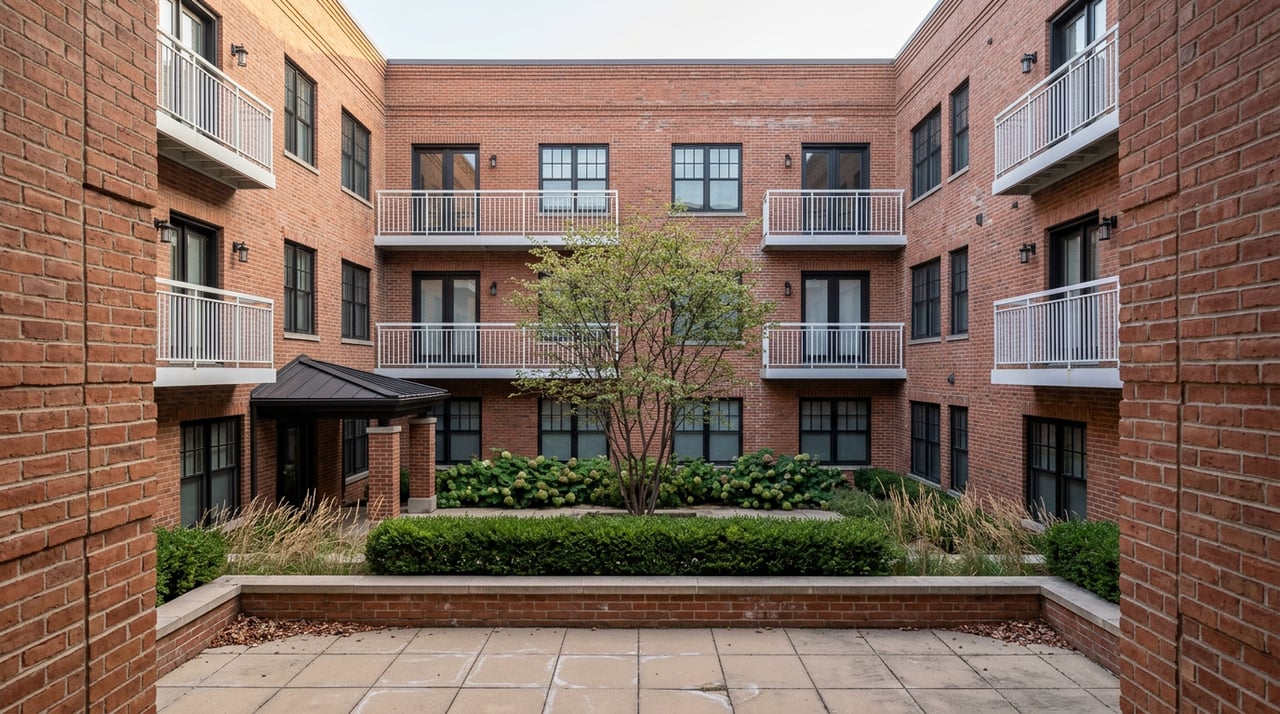
Silverton Condominiums, at 1201 East-West Highway, is a useful example because it's exactly the kind of building this affects. It's a five-story, 325-unit building completed in 2006 on the site of the old Canada Dry bottling plant, with monthly fees running roughly $400 to $800 that are supposed to cover exterior maintenance, insurance, management, and reserve funding. Other established associations in the area, like Park Bradford and Carolyn, carry the same structure: a monthly fee that bundles operating costs with a reserve contribution most owners never think about until something goes wrong.
The point isn't that any specific building is out of compliance. I haven't reviewed Silverton's current reserve study and I'm not suggesting it has a problem. The point is that a building this size, this age, with amenities like a pool and a fitness center that all carry replacement costs, is precisely the profile where the gap between "has a study" and "is funding to the study's recommendation" tends to show up. A pool resurfacing, an elevator modernization, a roof system nearing the end of its service life. These are the components a reserve study is built around, and they're also the components that create six-figure special assessments when a board has been underfunding for years.
Fannie Mae's own data on this is worth sitting with. As of August 2025, roughly 3.6 percent of condo projects nationally carried an ineligible status with the agency, and the two most common reasons were insufficient master insurance and critical repair issues, including failure to meet state or local inspection requirements. Underfunded reserves are exactly what produces both of those outcomes. A board that hasn't set aside money for a known repair eventually can't afford adequate insurance or lets a deficiency go unaddressed past an inspection deadline. The reserve study is the early warning. The ineligible status is what happens when nobody acted on the warning.
The document that actually answers the question
If you're buying or selling a condo in Silver Spring, Maryland law already requires the seller to hand over a resale package containing the governing documents, budget, reserve study, meeting minutes, and disclosure of any pending special assessments. Sellers order this through their association or management company, and it typically costs between $250 and $600, with turnaround running anywhere from ten to thirty days. That timeline is the part that catches people off guard. If a listing agreement gets signed and the resale package doesn't get ordered until an offer is already in hand, the closing date is the thing that slips.
Before you write an offer on a condo here, or list one, these are the questions worth asking directly:
- When was the last reserve study completed, and was it a full study or an update?
- Is the association funding at the study's recommended level, or has it adopted a documented hardship alternative under HB 292?
- Has the board discussed a special assessment in the last two years, even one that didn't move forward?
- Is the master insurance policy current, and does it reflect replacement cost rather than actual cash value?
- Has the association's lender-facing questionnaire been updated recently, or is it relying on an older certification?
None of these questions require a real estate license to ask. They require knowing that the reserve study, not the monthly fee, is the document that actually predicts whether your financing goes smoothly.
What your money actually buys right now
Context matters here too. Through January 2026, Silver Spring's median sold price sat around $492,000, with detached homes averaging roughly $615,000 and attached homes, the category that includes condos, averaging closer to $322,000. That gap is the reason condos remain the entry point into this market for a lot of buyers, and it's also exactly why the reserve study question deserves more attention than it gets. A buyer stretching to afford the lower end of that attached-home range is often the buyer with the least room to absorb a financing delay or a surprise assessment.
A few questions worth asking before you assume this doesn't apply to you
Does any of this apply to co-ops, not just condos? Yes. The same funding-plan requirement under Maryland law extends to cooperative housing corporations, which matters directly if you're looking at GHI in Greenbelt alongside a Silver Spring condo. The mechanics differ slightly by entity type, but the underlying question, whether the reserve is funded to what the study recommends, is the same.
If a building isn't compliant yet, does that mean I can't buy there? Not automatically. Lenders can request exceptions, and a board that's actively working through a documented funding plan is in a different position than one that's ignored the requirement entirely. It does mean you should ask the question before you're under contract rather than after.
Who actually pays for the resale package? By custom in this market, the seller orders and pays for it, though every term in a Maryland real estate contract is negotiable if both sides agree otherwise.
If you're weighing a condo purchase in Downtown Silver Spring, or you're a seller wondering whether your building's paperwork will hold up under a lender's current scrutiny, I'd rather answer that question for you before you're thirty days from closing than after. Kim Kash works this market from the co-op corridors of Greenbelt through the high-rises along East-West Highway, and the procedural groundwork is the same instinct either way. Let's connect.