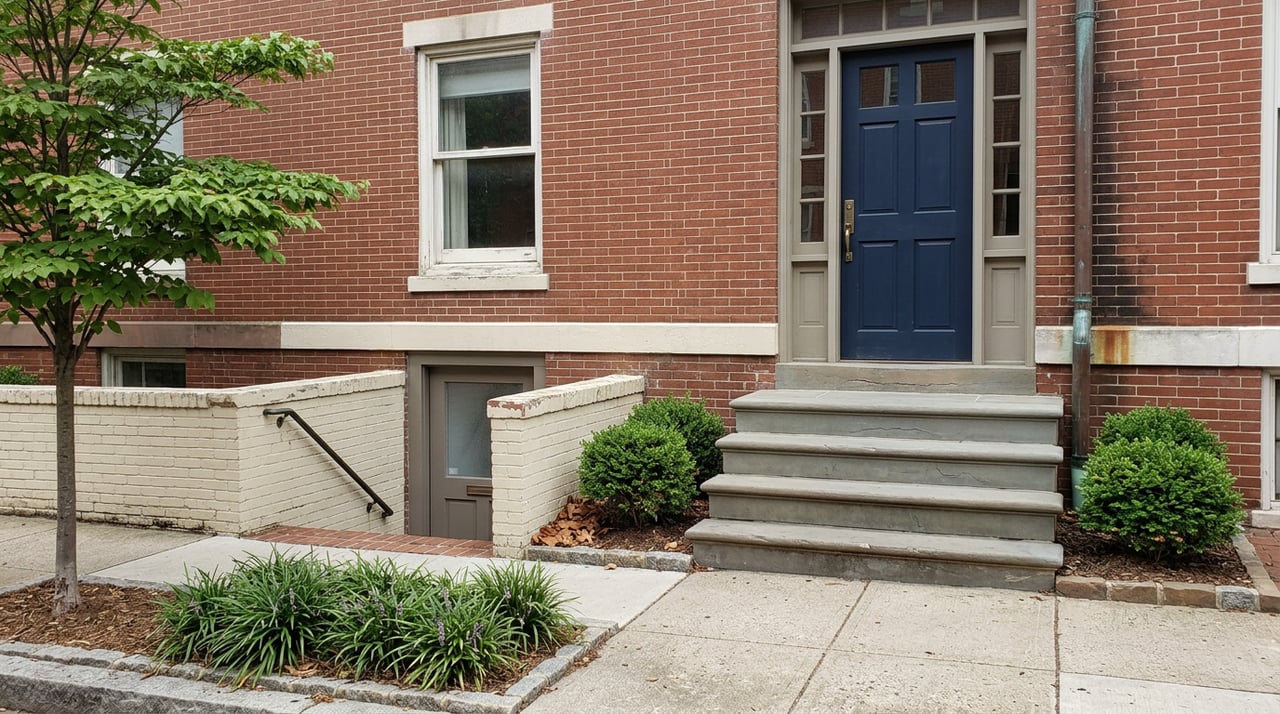
A seller near the H Street corridor called her agent this spring with a familiar worry. Her rowhouse has a finished English basement, rented out with its own entrance for the past four years. She had heard the stories, the ones every DC rowhouse owner eventually hears: a sale stalled for a year because a tenant claimed purchase rights, a homeowner paying a stranger thousands of dollars just to move the closing forward. She wanted to know if selling meant reopening that fight.
The honest answer changed on December 31, 2025, and most sellers with a basement unit like hers have not caught up to it yet.
The Fear That Built a Cottage Industry
DC's Tenant Opportunity to Purchase Act has required owners of rental housing to offer tenants first crack at buying since 1980. For most of that history, the law applied to single-family homes too, which meant a homeowner with one tenant in a basement apartment faced the same process as the owner of a fifty-unit building: notify the tenant, wait for a response, negotiate, and hope nobody assigned their rights to a third party looking for a payday.
That last part became the real story. One attorney interviewed by the NBC4 I-Team described the resale of TOPA rights as a "$100 million-a-year industry" in the District, built on tenants who had no intention of buying but plenty of interest in selling their leverage to whoever wanted the sale to close. The DC Council responded in 2018 with an exemption for single-family dwellings, and the celebration among homeowners was real. Ed Krauze, then CEO of the DC Association of Realtors, told reporters the change meant "somebody might be interested in opening their basement right now who wasn't before."
Here is the part that got lost in the celebration. The 2018 exemption covered single-family homes and single-family homes with an accessory dwelling unit, according to the DC Department of Housing and Community Development. It did not cover a property that had been formally converted into two separate legal units. If your rowhouse's basement apartment carries its own address, its own utility meter, or was permitted as a distinct unit rather than an accessory space attached to a single-family home, that property was never covered by the 2018 fix. It was still a multi-unit accommodation under the letter of the law, still fully exposed to the process that made the news in the first place.
Why the Distinction Lands Harder on H Street
This is not a technicality most neighborhoods need to think about. It matters here because H Street's rowhouse stock leans heavily toward exactly this configuration. Listings for basement units within a few blocks of the corridor routinely describe private front and back entrances, separate kitchens, and full independence from the unit upstairs, the kind of setup that reads as an income property rather than a spare room. UrbanTurf has reported for years that DC rowhouse buyers actively seek out homes with a rentable lower level specifically to offset a mortgage payment, and H Street's mix of century-old rowhouses and rising ownership costs makes that math attractive.
Attractive, and until recently, legally complicated the moment you tried to sell.
What Changed on December 31, 2025
The DC Council passed the Rebalancing Expectations for Neighbors, Tenants, and Landlords Act, known as the RENTAL Act, on its second reading on September 17, 2025. After the title insurance industry raised concerns about how the small-building exemption was worded, the Council held a third reading and passed the bill with amendments. Mayor Bowser signed it on November 13, 2025, it was transmitted to Congress on November 17, and Congress took no action during its review period. The law took effect December 31, 2025.
The provision that matters most for an H Street basement rental sits inside the small-building exemption. Buildings with two to four units are now exempt from TOPA, provided they are not majority-owned by a business corporation.
| Before December 31, 2025 | After December 31, 2025 | |
|---|---|---|
| Rowhouse with a legally separate 2-unit configuration | Full TOPA applied, individual owner or not | Exempt if owner is not majority-owned by a corporation |
| Compensation tenants could negotiate for assigning rights | Uncapped, subject to negotiation | Capped at the lesser of one year's rent or $12,000 |
| Assignment of rights after an offer of sale | Immediate | 22-day cooling-off period for 2-4 unit buildings |
| True single-family home with an accessory unit | Exempt since 2018 | Still exempt, unchanged |
The cap on negotiated compensation, detailed in Arnold & Porter's summary of the Act, is worth sitting with. It directly targets the mechanism that built the resale market the 2018 reform tried and failed to fully close for anyone outside a true single-family home. A tenant can still negotiate for relocation assistance, but the number now has a ceiling.
The Paperwork That Still Follows You Even When You're Exempt
Exemption is not the same as skipping the process. Even a fully exempt sale requires a Notice of Transfer to every tenant, and that notice gives tenants 45 days to register a tenant association if they want to contest the exemption itself. It rarely gets contested when the exemption is legitimate, but the notice still has to go out, and it still has to be documented for the title company.
There is also a deadline that has already passed and is easy to miss. Under guidance from Ballard Spahr's client alert, landlords of properties that became newly exempt under the RENTAL Act were required to notify their existing tenants in writing of the exemption by March 31, 2026. If you have owned your H Street rowhouse's basement rental since before the law changed and never sent that notice, a title company is likely to flag the gap before your closing, not after.
A few things worth confirming before you list a rowhouse with a basement tenant this fall:
- How the property is titled. A single owner or a family trust likely qualifies for the small-building exemption. An LLC or corporation that holds majority ownership does not.
- Whether the basement is legally an accessory unit to a single-family home or a separately permitted second unit. This determines which exemption applies and has applied for years.
- Whether the March 31, 2026 written notice of exemption was sent to your current tenant, if the tenancy predates the law change.
- Whether a Notice of Transfer is prepared and ready to go out alongside your listing paperwork, not after you have an accepted offer.
Federal Title's March 2026 summary of the RENTAL Act notes that several provisions remain subject to interpretation as DHCD issues further guidance. That is not a reason to guess. It is a reason to have someone who tracks this specific law reviewing your file before it reaches a lender's desk.
What This Means If You're Listing This Fall
Under the old framework, a full TOPA process on a non-exempt property could stretch well past a year once you accounted for tenant association formation, negotiation windows, and financing timelines. For an H Street seller whose basement tenant would previously have triggered that entire sequence, the small-building exemption removes months of uncertainty from a transaction that used to carry it by default. That is the shift worth understanding before you price your listing or set a closing date. It does not remove the paperwork. It changes which paperwork actually controls your timeline.
Does the exemption apply automatically, or do I still need to do something?
It does not apply automatically in practice. You still need to send a Notice of Transfer, and if your tenancy predates the law, you needed to have sent written notice of the exemption by March 31, 2026. A title company will ask for both before closing.
What if my basement tenant has lived there since before 2018?
The RENTAL Act's exemptions are based on building size and ownership structure, not how long a tenant has occupied the unit. The narrow elderly or disability protections written into the original 2018 single-family exemption applied only to tenants who signed leases by March 31, 2018, which makes that carve-out unlikely to affect a current tenancy in 2026. Confirm your specific situation with a title company experienced in TOPA compliance rather than assuming either way.
Does it matter if I own the rowhouse through an LLC?
Yes. The 2-4 unit exemption applies only when the property is not majority-owned by a business corporation. If your rowhouse is titled to an LLC, that ownership structure needs to be reviewed against the current law before you assume the exemption applies.
If you own a rowhouse near H Street with a basement rental and you are trying to figure out where your property actually falls under the new law, that is exactly the kind of procedural question worth working through before you list, not during a contract deadline. Kim Kash has spent years untangling co-op and rowhouse transaction mechanics across the DC metro fringe. Let's connect and look at your specific setup together.